
Flow: The Missing Link Between Healing, Manifestation and the Life You Were Born to Live
There is a reason some days feel effortless while others feel like you’re trying to walk through wet cement.
The difference is rarely intelligence.
It’s rarely motivation.
And it certainly isn’t because one person is “lucky” while another isn’t.
More often than not, the difference lies in the state of the nervous system.
When your nervous system feels safe, your body works with you. Your thinking becomes clearer. Your breathing deepens. Your creativity expands. You make decisions with greater confidence. You communicate more effectively. You notice opportunities that you may have overlooked before.
Life begins to flow.
But when your nervous system is locked in protection, everything changes.
Your muscles tighten.
Your jaw clenches.
Your digestion slows.
Your sleep becomes lighter.
Your thoughts become repetitive.
Your body conserves energy for survival instead of repair.
It's not because you are weak.
It’s biology.
Our brains evolved to keep us alive, not necessarily to keep us happy. Deep within the brain sits the amygdala, a structure constantly scanning for danger. When it detects a threat, whether physical or emotional, it signals a cascade of responses through the autonomic nervous system and the hypothalamic-pituitary-adrenal (HPA) axis. Stress hormones such as cortisol and adrenaline prepare the body to fight, flee or protect itself.
For short periods, this response is extraordinary.
It saves lives.
The problem is that many of us no longer experience stress as an occasional event.
We experience it as a lifestyle.
Emails.
Financial pressure.
Relationship difficulties.
Childhood experiences.
Grief.
Poor sleep.
Constant notifications.
Negative self-talk.
The nervous system often cannot distinguish between a charging predator and years of chronic emotional pressure. It simply responds to the messages it receives.
Eventually, protection becomes familiar.
The body adapts to surviving.
But surviving and thriving are not the same thing.
One of the most remarkable discoveries in neuroscience over the past few decades is neuroplasticity: the brain’s ability to change throughout life. Every repeated thought, behaviour and emotional response strengthens neural pathways. The more frequently we think a certain way, the more efficient those pathways become.
In simple terms, the brain becomes better at whatever it practises.
If it repeatedly practises fear, it becomes efficient at fear.
If it repeatedly practises gratitude, curiosity, calm and resilience, those networks become stronger too.
This doesn’t mean positive thinking magically changes reality overnight.
It means that changing how we think and respond can literally influence how our brains are wired over time.
Isn't this empowering?
Because it reminds us that while we cannot control every circumstance, we can gradually reshape how our nervous system experiences the world.
This is where the idea of flow becomes so powerful.
Flow isn’t about never facing challenges.
It isn’t pretending life is perfect.
It isn’t bypassing pain.
Flow is what happens when resistance begins to soften.
Think of a river.
When there are obstacles, the water doesn’t argue with the rocks.
It moves around them.
It adapts.
It continues.
Human beings often do the opposite.
We resist uncertainty.
We replay old conversations.
We anticipate disasters that never happen.
We judge ourselves relentlessly.
Every one of those experiences creates another message for the nervous system.
“Stay alert.”
“Don’t relax.”
“Something bad might happen.”
Now imagine replacing some of those messages.
“I am safe in this moment.”
“My body knows how to adapt.”
“I don’t have to control everything.”
Those aren’t simply affirmations.
They’re invitations for the nervous system to experience a different reality.
Gratitude is one of the simplest ways to begin creating that shift.
Research has shown that regular gratitude practices are associated with improved emotional well-being, better sleep and reduced perceived stress. Gratitude changes where attention is directed. Instead of constantly scanning for what is missing, the brain begins recognising what is already present.
That subtle shift matters.
Because attention shapes perception.
And perception influences behaviour.
When we feel calmer, we often think more creatively, solve problems more effectively and connect more deeply with others.
To many people, that feels like manifestation.
From a neuroscience perspective, it is also a change in cognition, emotion and behaviour that opens us to possibilities we may previously have missed.
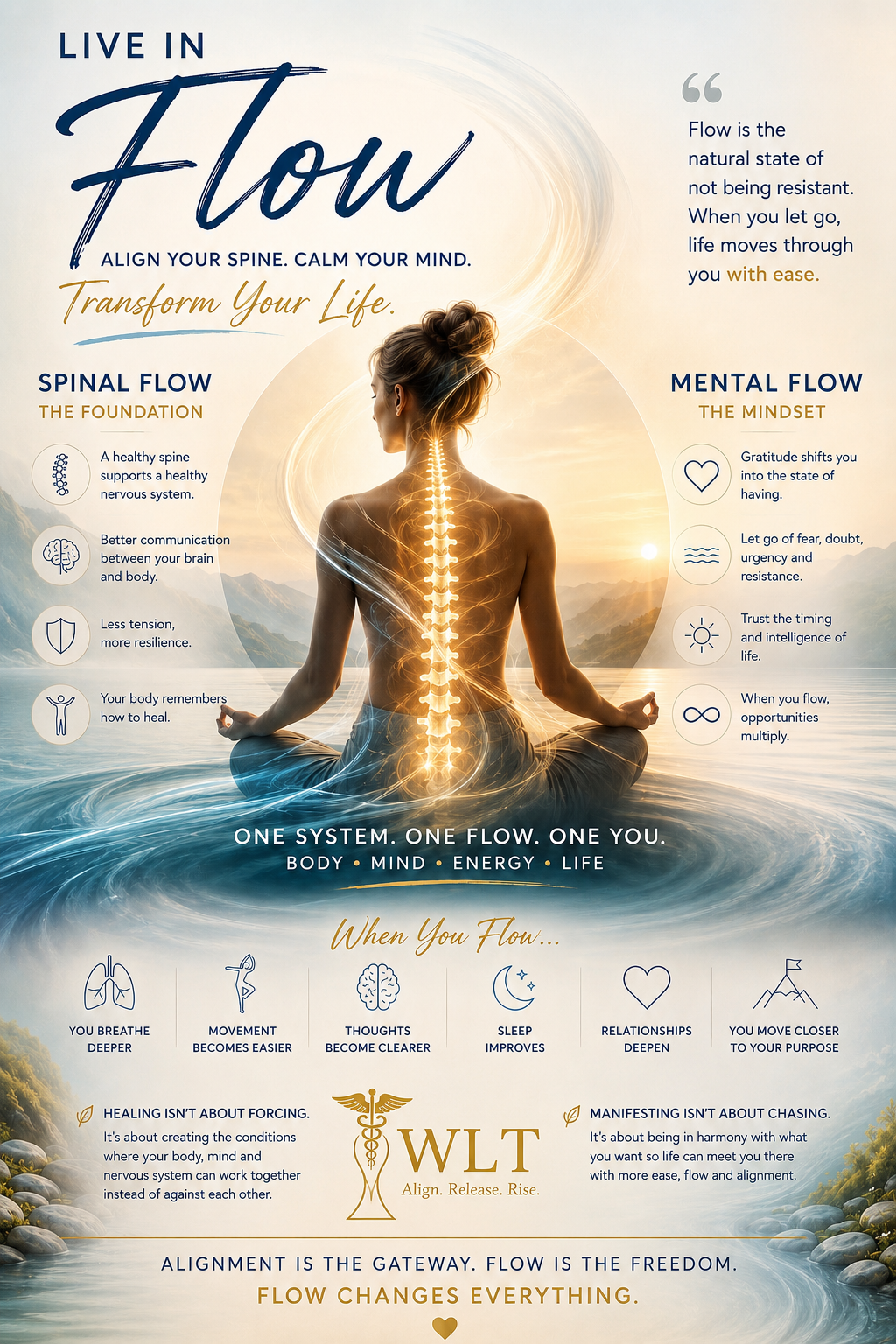
This understanding beautifully complements my work with Spinal Flow.
The philosophy of Spinal Flow recognises the incredible intelligence of the human body. Rather than forcing change, it seeks to support the nervous system and create an environment where the body can express its own innate capacity for adaptation.
Our spine protects one of the most extraordinary communication systems in existence.
Every sensation.
Every movement.
Every heartbeat.
Every breath.
Every thought.
Every emotional experience is influenced by the ongoing conversation between the brain and the body through the nervous system.
When that communication becomes more efficient and the nervous system feels less overwhelmed, many people describe feeling calmer, more connected and more present.
Those experiences are deeply meaningful because they reflect a body beginning to move away from constant protection and towards greater regulation.
Healing is rarely a single moment.
It is a process.
So is growth.
So is creating the life you want.
Authors such as Joe Dispenza, Bruce Lipton and Gregg Braden have encouraged millions of people to consider the relationship between thoughts, beliefs and human potential. While some of their interpretations extend beyond what mainstream science has established, one principle resonates across both scientific research and lived experience: our internal state influences how we experience our external world.
The way we think affects our physiology.
The way we breathe affects our nervous system.
The way we perceive stress affects our biology.
And the way we repeatedly respond to life gradually shapes the brain itself.
Perhaps flow isn’t something we have to chase.
Perhaps it has always been there.
Beneath the tension.
Beneath the fear.
Beneath the habits that taught us to brace instead of breathe.
Maybe flow is simply what remains when the nervous system remembers that, for this moment, it is safe.
Because when the mind becomes quieter…
The body becomes wiser.
When the body feels safer…
Healing becomes more possible.
And when healing begins…
Life doesn’t necessarily become easier.
But it often becomes lighter.
More connected.
More intentional.
More alive.
That is the power of flow.
Align. Release. Rise.
